
Programme Requirements
- Meet with your Language Partner(s): Minimum of 5 meetings, each lasting at least 40 minutes
- Submit post-meeting logs
- Submit pre- & post- programme questionnaire
Participants who successfully complete the programme requirements can receive the BRIDGE certificate and digital credential which can be shared on social media platforms such as LinkedIn.
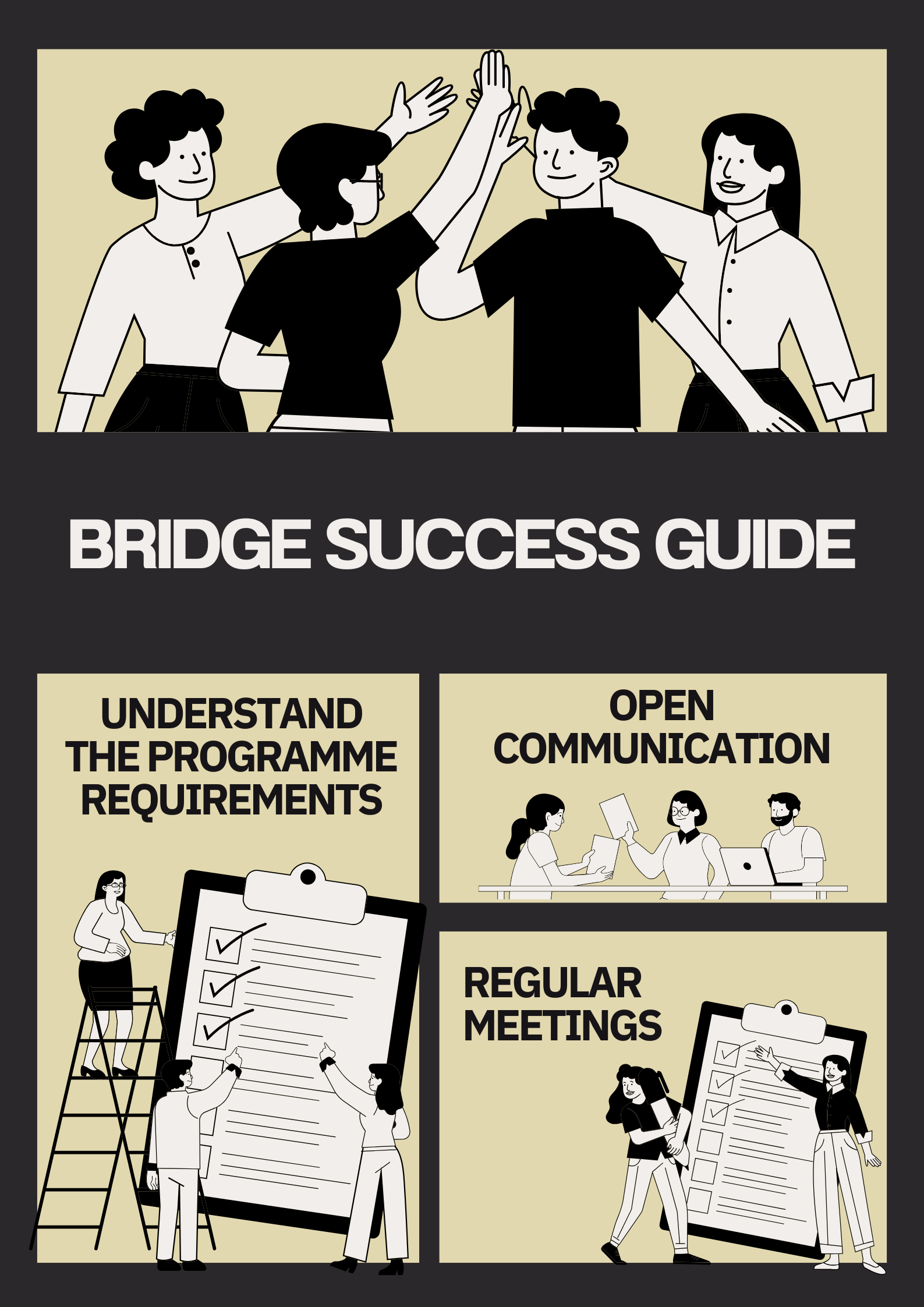
BRIDGE - 10 Steps to Success:
A Practical Guide to Language & Cultural Exchange Participants
Your BRIDGE journey is not just about language and cultural exchange, it’s about connection, growth, and global understanding.
Follow these 10 steps BEFORE, DURING, and AFTER THE MEETING to make the most of your BRIDGE experience:
Start by discussing what you hope to gain from the exchange and how you prefer to communicate. Your learning goals and communication styles—along with your partner’s—will shape how your meetings unfold. Be open, honest, and collaborative as you co-create a format that works for both of you.
Feel free to use the BRIDGE Pre-Meeting Checklist to guide your discussion.
1. Share Learning Expectations
Clear goals lead to focused, productive meetings.
a. Your goals: What language are you learning, and what is your current level (beginner/ intermediate/ advanced)? What are the specific language skills that you want to focus on? Are you aiming to improve your pronunciation, listening skills, or fluency? If so, opt for real-time video or in-person meetings. Seeing each other’s facial expressions and mouth movements (e.g. tongue placement, jaw movement) is especially helpful for improving speaking skills and comprehension.
b. Your partner’s goals: You play an important role of being your partner’s teacher, so note down your partner’s learning goals, and ask how you can help: Do you need to speak slower or use simpler language to suit your partner’s language level? What can you prepare to teach your partner? What vocabulary or cultural insights can you share?
Bringing discussion questions, useful phrases, or a short teaching moments helps keep the conversation flowing and ensures both partners benefit from the exchange.
2. Discuss Communication Styles
Once your learning objectives are clear, take time to share how you prefer to communicate. This helps create a supportive environment for mutual learning. Consider the following:
a. Personality & comfort level: Are you more introverted or extroverted? Do you need time to warm up with new people, or do you enjoy spontaneous conversation?
Example: “I usually take time to feel comfortable with new people – thanks for your patience!”
b. Feedback preferences: How do you want to be corrected, and how often? Every time you made a mistake, or only when meaning is unclear? Do you prefer gentle corrections or direct feedback? Are you okay with being interrupted, or does it disrupt your flow?
The key is to let your partner know what makes you feel most comfortable, so you can both learn effectively and enjoy the process.
3. Prioritize Real-Time Interaction
To ensure mutual engagement, schedule live meetings—whether face-to-face, via Zoom, or on WhatsApp call. These allow for immediate feedback, richer conversation, and stronger connection. Avoid relying solely on asynchronous voice/text messages, as waiting for replies while your partner is busy elsewhere can feel frustrating and unproductive.
4. Plan Ahead
Scheduling your meetings in advance helps build consistency and mutual accountability. Together, agree on:
a. Meeting times that fit both your schedules
b. Topics you’d like to explore
c. Formats that support your learning goals – face-to-face, video call, or voice call
d. Platforms that are accessible and reliable for both of you (E.g. Zoom, WhatsApp, WeChat)
Add the meetings to your calendar and confirm details ahead of time. A quick message like: “Remember our Zoom chat tomorrow at 6pm? Let’s dive into Festivals!” goes a long way in keeping things smooth and respectful.
If you need to reschedule, let your partner know as early as possible. Clear communication shows consideration and keeps the exchange enjoyable and productive for both of you.
5. Respect Meeting Etiquette
Thoughtful communication is the cornerstone of meaningful intercultural exchange. These principles will help you foster respectful, engaging, and inclusive conversations.
- Communicate with care: Misunderstandings can occur in intercultural settings – especially when language proficiency, cultural norms, and personal styles differ. When something feels off or confusing, respond with curiosity rather than judgement. Ask thoughtful questions to clarify meaning or intent. For example:
“Could you explain what you meant by that?”
“In my culture, that phrase might sound unusual – can we talk about it?”
Focus on building mutual understanding through respectful dialogue. Avoid assumptions and instead ask respectful questions when something feels unexpected. Use polite language and maintain a positive tone, especially when offering feedback. For example, saying “That’s wrong” might feel normal to you, but could sound harsh to a partner who’s still building confidence in a second language. A softer alternative like “That’s a common mistake – here’s another way to say it” preserves trust and encourages learning. - Respect Boundaries: While open communication is encouraged, it is equally important to recognize and respect personal limits. Avoid probing into sensitive topics in politics, religion, or private matters unless your partner invites the conversation. When in doubt, ask:
“Is it okay to talk about this?”
If your partner seems hesitant, move on to a different topic with care and respect. - Foster Open-Mindedness: Approach each meeting with curiosity and a willingness to learn from perspectives different from your own. Cultural norms vary widely – what feels “awkward” or unfamiliar to you could be perfectly natural elsewhere. For instance, direct eye contact might signal confidence in one context but be seen as confrontational in another.
- Be Self-Aware: Reflect on how your own habits, assumptions, and communication style might be received. Your tone, delivery, nonverbal cues – such as facial expressions, gestures, and posture – may carry different meanings across cultures. One way to identify if you need to adjust your behaviour is to notice your own emotional responses, especially when negative emotions are involved: If you feel frustrated, impatient, or awkward during a conversation, pause and ask yourself why. Are you expecting the exchange to follow your own cultural norms? Naming your reactions help you respond thoughtfully rather than reactively.
- Stay fully present: A true exchange happens when both participants are fully present, i.e. devoting full attention to each other during the meeting. Therefore, avoid multitasking, and if something urgent arises, it is better to excuse yourself briefly than to divide your focus (E.g. Would you mind if I step away for 3 minutes to take a quick call?”).
In short, meeting etiquette is all about one word: thoughtfulness!
Think and reflect on your own responses and actions, and consider how your partner might feel. Thoughtful communication is the foundation of respectful and effective intercultural exchange.
If any inappropriate situations occur, don’t hesitate to seek advice or support from us.
6. Optimise Learning Experience
Approach each meeting with a clear intention and shared enthusiasm to make your exchange sessions meaningful and productive:
a. Choose a Focused Topic: Before each meeting, agree on a topic that interests both you and your partner. A focused theme helps guide your conversation, keep it engaging, and allows both of you to prepare relevant vocabulary, questions, or examples in advance.
b. Come Prepared to Teach and Learn: Remember, this is a two-way exchange. You’re not only here to practice your target language, you’re also a cultural and linguistic resource for your partner. Bring something to share: a photo/ song/ recipe that sparks discussion; a few useful phrases or expressions; cultural tradition or custom; etc.
Think of yourself as both a learner and a peer educator. Preparing a small “teaching moment” for each meeting helps build your confidence and your partner’s learning motivation.
7. Balance Time & Participation for Shared learning
Divide the time equally so both you and your partner have equal chance to learn and practice. Setting a timer might seem awkward at first, but it can help prevent one-sided conversations and ease any worries about taking up too much time. That said, flexibility and respect is key. If you’re immersed in an in-depth discussion and the timer goes off, it’s okay to ask: “Do you want to continue with this topic? Or if you’re short on time, we can switch to your practice now.”
8. Conclude with Reflection
As your meeting wraps up, take a moment to reflect on what you’ve learned and thank your partner for their time and insights. A simple gesture of appreciation helps build trust and reinforces the value of shared learning.
Before you part ways, spend one minute to complete the Post-Meeting Log. Highlighting your key takeaways and reflecting on your experience supports continuous growth and helps you track your progress over time.
9. Deepen Your Reflection
Sometimes the most meaningful insights emerge after the conversation ends. Let your experience sink in and try these structured reflection strategies:
a. Ask Specific Questions: What was the most memorable part of the meeting? What surprised you? What challenged your assumptions?
b. Use Reflective Phrases: “I noticed that…”, “This made me realize…”, “A key takeaway for me was…”, “I wonder how this connects to…”
c. Support Your Partner: To guide your partner to understand a cultural aspect, try: “In my culture, this is important because…”, “How does this compare to your experience?”, “What questions do you have about this tradition?”
10. Prepare for the Next Meeting
Based on what you and your partner agreed to talk about in the next meeting, prepare a few questions, phrases, or cultural insights to share and explore. If you’re just beginning to learn a new language, preparation is especially helpful. Look up questions you’d like to be asked and rehearse your answers in advance. Prior to the next meeting, learn key vocabulary related to your chosen topic — this builds confidence and helps you participate more actively in the conversation. Even if you’re at an intermediate or advanced level, bringing a visual or topical resource — such as a photo, article, or short video — to the meeting adds variety and depth to your exchange. It’s a great way to spark curiosity, share perspectives, and keep the conversation flowing.
Embrace the BRIDGE Experience with Curiosity
It’s completely natural to feel uncertain or less confident when learning a language. But the BRIDGE experience is all about growth—through practice, partnership, and respectful communication.
During your exchange, take every opportunity to actively use your language skills and support your partner in theirs. Mistakes are not only expected—they’re essential to learning. You might even say something that sounds unusual or awkward in another cultural context, and that’s part of the joy of discovery.
What matters most is creating a space that’s fun, friendly, and open. Laugh together at misunderstandings, learn from them, and celebrate the “aha!” moments. This is how you build cultural bridges—and hopefully, by the end of the programme, a meaningful connection with your partner as well.